
Santak PT3000 Lingxiao series UPS
A 1-3 kVA online double-conversion UPS with cloud monitoring built in — check status and receive alerts on your phone, pair it with lead-acid or lithium batteries, and run it in 0-50 C sites.
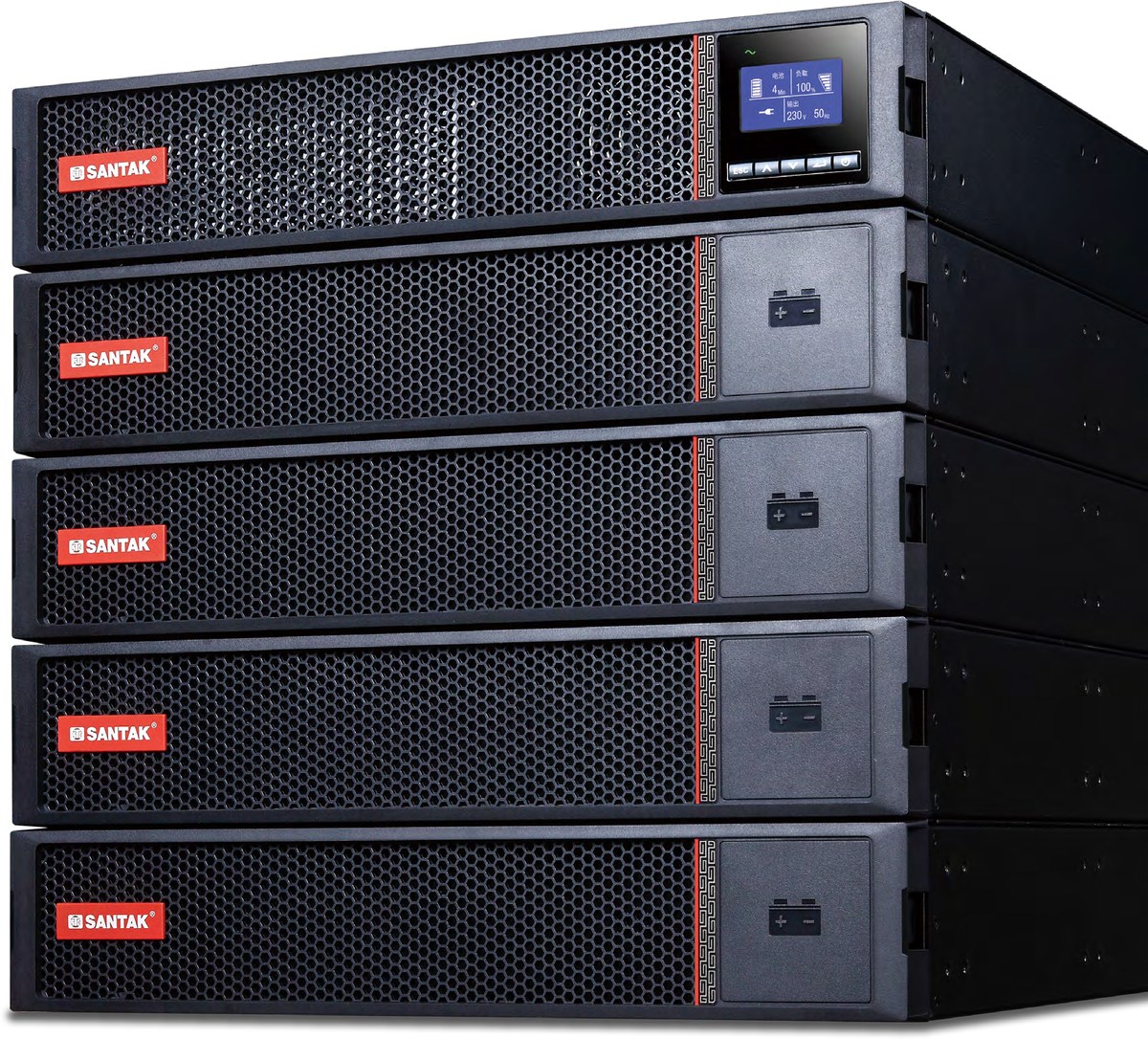 Product photo
- Brand
- Santak
- Type
- Online double-conversion (IoT cloud-monitored UPS)
- Typical use
- Remote monitoring of distributed sites, small machine rooms, office equipment
- Models covered
- PT1K-i (1 kVA/1 kW) / PT1KS-i (long-runtime), PT2K-i (2 kVA/2 kW) / PT2KS-i (long-runtime), PT3K-i (3 kVA/3 kW) / PT3KS-i (long-runtime), Lithium battery cabinets PTB9032-i / PTB9062-i (optional)
- Category
- UPS systems / Santak
Why a UPS needs cloud access
Traditional UPS monitoring means installing software, wiring serial cables and buying network cards — and distributed sites often stay unwatched until something fails. The PT3000 builds cloud connectivity into the host, which changes three things:
- Status on demand — the mobile APP shows mains, load and battery status for every unit, with multi-user tiered access
- Alerts that push themselves — mains anomalies and UPS faults notify the APP in real time, with one-tap service reporting to Santak support
- Remote maintenance — trigger battery self-tests from the APP instead of pressing buttons on site
What to confirm before ordering
- Internal batteries or not — -i models (internal batteries, still expandable) or -S models (pure long-runtime, EBM only); this also decides chassis depth and weight (445 mm vs 600 mm).
- Runtime target — the brochure lists runtime for 1–4 EBM cabinets at half/full load; send us the load in watts and we will size the cabinets.
- Lead-acid or lithium — lithium cabinets are smaller, cycle longer and carry a 5-year warranty, at a higher upfront cost; weigh against service life and space.
- Network conditions — cloud monitoring needs a network cable or WiFi on site; fully offline sites fall back to local USB/RS232 monitoring.
We supply the full Santak PT3000 range and EBM cabinets in Hong Kong with site survey, sizing, installation, cloud platform onboarding and maintenance. Sizing before quotation is free — send us the load list, number of sites and network conditions, and always confirm the full model suffix (-i/-S) and accessory list before purchase.
Key features
- Cloud connection standard over RJ45 (network cable or optional WiFi) — APP monitoring, real-time alerts, one-tap service reporting
- Runs lead-acid batteries or Santak lithium cabinets with in-house BMS (LiFePO4 cells, three-tier protection, IEC62133/UL1642 certified cells)
- Output power factor 1 (VA = W); up to 93% efficiency online
- 0–50 C operating range, no derating up to 3000 m, conformal-coated boards
- Rack or tower 2U install, with an independently controllable output group for load prioritisation
Frequently asked questions
How does the PT3000 differ from the ES series?
What does -S mean in PT1KS-i?
Is a monitoring card needed for remote access?
Related models & accessories
Santak ES series
An online double-conversion UPS built for renewable energy storage sites — 2U rack mount, unity output power factor, UL and CE certified, with external battery cabinets for extended runtime.
View details山特 SANTAK UPS 不斷電系統
View detailsEATON 9PX series
The mainstream choice for server rooms: online double-conversion keeps the output fully isolated from the mains, with efficiency and serviceability at practical levels.
View detailsSpecifications
| Models and rating | PT1K-i / PT2K-i / PT3K-i (1/2/3 kVA, VA = W); -S variants without internal batteries |
|---|---|
| Topology | Online double-conversion, sine wave output |
| Output voltage | 220 V default (200/208/220/230/240 V selectable), ±1% |
| Input range | 110–300 VAC (derating below 160 VAC) |
| Battery voltage | 36 VDC (PT1K-i), 72 VDC (PT2K-i/PT3K-i); EBM cabinets PTB9032-i / PTB9062-i |
| Efficiency | 91–93% online; 96–97% ECO mode |
| Overload | 125% for 10 minutes |
| Communications | USB, RS232, dry contacts, RPO, smart slot, RJ45 (cloud), WiFi (optional) |
| Size and weight | 2U rack/tower (438 × 445/600 × 85.5 mm), 8.0–26.2 kg |
| Environment | 0–50 C, 0–3000 m without derating, IP20 |
| Certification and warranty | TLC / CE / CQC; 3-year UPS warranty (5 years for lithium UPS and cabinets) |
Specifications follow the manufacturer's latest data. Actual configuration must be sized against the site load, required runtime and distribution environment — this table is for selection reference only.
Specification sheets follow the latest manufacturer revision. For other technical documents, ask us and we will send them over.