
EATON 93PR modular UPS (25–1200 kW)
Buy for today's load, plug in modules when it grows — the 93PR solves the capacity-planning problem that makes data-centre UPS projects overspend.
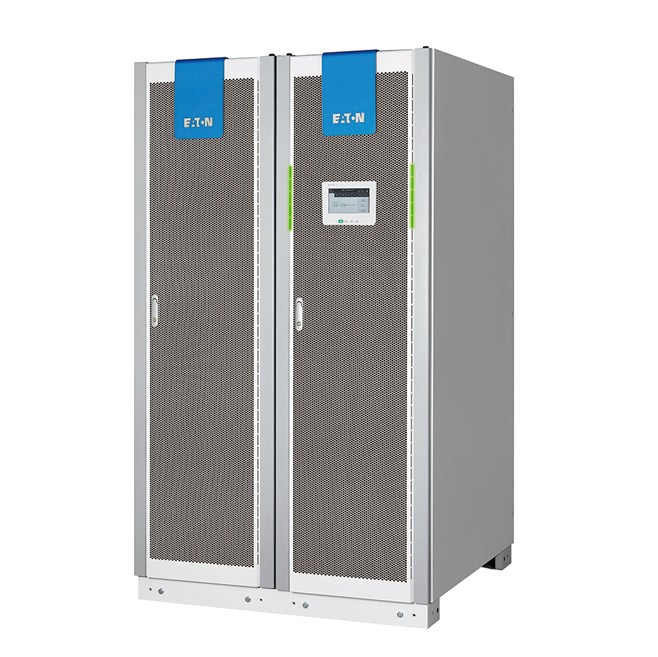 Product photo
- Brand
- EATON
- Type
- Three-phase modular online double-conversion
- Typical use
- Mid-to-large data rooms, staged expansions, medical and automation
- Models covered
- EATON 93PR 25–200 kW, EATON 93PR 60–1200 kW
- Category
- UPS systems / EATON
The capacity-planning argument
Data rooms rarely fill up in the order or at the speed the plan assumes. The 93PR's frame-and-module design matches that reality: install the frame once, start with the modules today's load needs, add more as rows go live. The alternative — an oversized fixed frame — ties budget to capacity that may sit idle for years.
What we design around it
At this scale we deliver the system, not a carton: input and output distribution, battery strings with their own room or cabinets, monitoring, and a commissioning test witnessed against the measured load. Module count and redundancy (N, N+1, 2N) are settled at design stage with the load data, not estimated.
Key features
- Up to 8 frames of different ratings in parallel, expandable to 4.8 MW
- Double-conversion efficiency up to 97.5%; over 99% in ESS eco mode
- Three-level topology with VMMS module sleep — idle modules power down at light load
- Output power factor 1.0 — full rating usable
- Redundant fans and power modules
- External battery cabinets and racks engineered to order
- IPM power-management and IPP automated-shutdown software included
Frequently asked questions
Why modular instead of a fixed frame?
What does a module swap involve?
Related models & accessories
EATON 93PR Tower series
300–600 kW in a single tower: a high-power frame built to military-grade quality requirements, for large data centres and critical industrial facilities.
View detailsEATON 93PX / 93PR series
The value of modular is not raw capacity — it is that a failed module does not stop you, and growth does not mean replacing the frame.
View detailsData centres and server rooms
A power cut in a server room does not cost you a few minutes of downtime — it costs corrupted data, interrupted services and customers. Backup power has to be right on three counts at once: capacity, redundancy and runtime.
View detailsSpecifications
| Power platforms | 25–200 kW; 60–1200 kW |
|---|---|
| Output power factor | 1.0 |
| Rated voltage | 380 / 400 / 415 V |
| Frequency | 50/60 Hz |
| Efficiency | Up to 97.5% double-conversion; >99% ESS mode |
| Paralleling | Up to 8 frames (mixed ratings), 4.8 MW total |
Specifications follow the manufacturer's latest data. Actual configuration must be sized against the site load, required runtime and distribution environment — this table is for selection reference only.