
CSB GP series batteries
A standard battery specification for small UPS and security equipment. When replacing them, the thing that matters is not the brand — it is replacing the whole string.
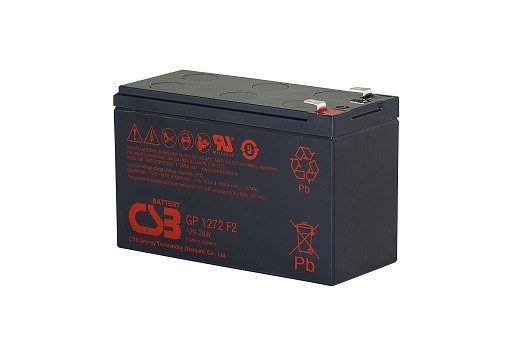 Product photo
- Brand
- CSB Battery
- Type
- Valve-regulated lead-acid (AGM)
- Typical use
- Small UPS, access control, CCTV, instruments
- Models covered
- CSB GP1272 F2 (12 V 28 W), CSB GP series, other capacities by model
- Category
- Batteries and battery packs / VRLA / AGM batteries
The three most common mistakes when replacing small batteries
Mistake one: checking the voltage but not the terminal. A 12 V battery may have F1, F2 or another tab width. If it does not fit, the money is spent for nothing. A photograph of the label settles it in seconds.
Mistake two: treating Ah and W as the same thing. "28 W" and "7.2 Ah" both look like numbers, but they are capacities on different bases. Convert on the wrong basis and you can buy a battery that is clearly too small — and end up with less runtime than you started with.
Mistake three: replacing only the failed block. In a series string, the weakest block sets the performance. Replace one and you have mixed old with new; the new block never reaches full charge and the problem returns quickly. Replacing the whole string from one batch is the cheaper approach.
Our replacement service
- Confirm the specification — send a photograph of the label or the UPS model and we check voltage, capacity marking and terminals.
- A site visit to measure — confirm replacement is really needed; sometimes it is a UPS setting or the load.
- Whole-string replacement — same brand, same batch, no mixing.
- An actual discharge test — measured runtime after replacement, with the figures handed over.
- Old battery collection — disposal that meets the environmental requirements.
The battery is not the most expensive consumable in the system, but it is the only part that makes a UPS fail at the moment it is needed. It is worth handling properly.
Key features
- Valve-regulated (VRLA): no topping up, no acid mist
- A widely used industry specification, so interchangeability is good
- Low self-discharge, suited to long standby duty
- Capacity may be marked in watts (W) or amp-hours (Ah) — check the unit when specifying
- For small UPS, access control, CCTV and instruments
Where it fits
Small UPS replacement
Replacement of the original battery specification in domestic and small UPS units, with good compatibility.
Access control and CCTV
Keeps controllers and recorders running through an outage.
Instruments and emergency lighting
Low self-discharge suits long periods on standby.
Frequently asked questions
What is the difference between 28 W and 7.2 Ah?
Do the terminals (F1 / F2) matter?
Can I substitute a different brand at the same specification?
Related models & accessories
CSB GPL series
A long-life specification built for machine-room UPS strings — the difference is not at the start, it is whether you replace them again a few years later.
View detailsLEOCH DJ series (12 V AGM)
The battery type small equipment uses most. Compact and maintenance-free — but there is one rule that has to hold when you replace them.
View detailsSPRM1KL battery pack
The original battery pack for a rack-mount UPS — replacing the whole pack is more reliable than assembling it block by block, and it lasts longer.
View detailsSpecifications
| Voltage | 12 V (per block) |
|---|---|
| Capacity marking | By model — may be Ah or W; the two are different and need converting |
| Type | Valve-regulated lead-acid (AGM) |
| Terminal type | F2 and others — confirm before replacing |
| Design life | Around 3–5 years on float, depending on conditions |
| Maintenance | No topping up; annual testing recommended |
| Typical equipment | Small UPS, access control, CCTV, instruments, emergency lighting |
Specifications follow the manufacturer's latest data. Actual configuration must be sized against the site load, required runtime and distribution environment — this table is for selection reference only.